Read Stories About african adventure

“Thorn. Can I talk to you?”
“I have arranged for the mountain rescue team to take
you down. You leave immediately,” he said, looking at my puffy face.
And just like
that, after four incredible days, my stab at getting to Mt Kenya’s Lenana peak
came to a dramatic end.
That I was probably the most enthusiastic among the
hiking party did not matter. My ego, mental and physical readiness for the
glory the summit would reward, offered little resistance to the facts that I
had been made aware before the hike began.
See, Mt Kenya and her sister across the border, Mt
Kilimanjaro, offer great non-technical climbs for hikers across the world.
Their location on the equator makes them an appealing choice due to milder
temperatures compared to other mountains of a similar altitude. Fatal
attraction, however, best describes these twin mountains that despite not being
among the top 100 highest peaks have acquired notoriety for altitude-related
incidents. Anyway, a cup of ‘Kenyan mixed’ tea downed in strained haste, teary
farewell hugs, and in less time than I had taken on the barren Simba Tarn camp,
I had been evacuated. A brief nursing session at Nanyuki’s Cottage Hospital and
my pulse oximeter readings had rebounded to safe range of 95, far from the
fallen 56 reading.
Make no mistake. This is how you should deal with
emergencies on the mystical snow-capped mountain located on the equator. That
or you risk suffering the adverse effects of Acute Mountain Sickness that if
not picked out early can turn a leisure activity into a tragedy.
Allow me to bore you with some facts. Sudden exposure
to high altitudes causes an array of signs and symptoms first noted sometime
between 37 and 32 BC by a Chinese government official who observed “a man’s
face turns pale; his head aches and he begins to vomit” when crossing the
Himalayan Kilak Pass. This region later became known as “Big Headache and
Little Headache Mountains.” It wasn’t until roughly 1975 that the term HACE (High-Altitude
Cerebral Edema) was recognised in medical and mountaineering literature. Not to
alarm you but, everyone traveling to altitude is at risk, regardless of age,
level of physical fitness, prior medical history, or previous altitude
experience. Thankfully, this is a rare
condition, occurring in less than one per cent of people who ascend to 4,000
metres (13,000 ft) and is a clinical diagnosis that in most cases does not
require an MRI.
In my case, a puffed-up face accompanied by a headache
was potentially the onset of HACE, which is the manifestations of brain
pathophysiology. After a warm bath and a belly soaked in celebratory wine and a
sirloin steak at the boutique Soames Hotel, I reminisced with peak clarity the
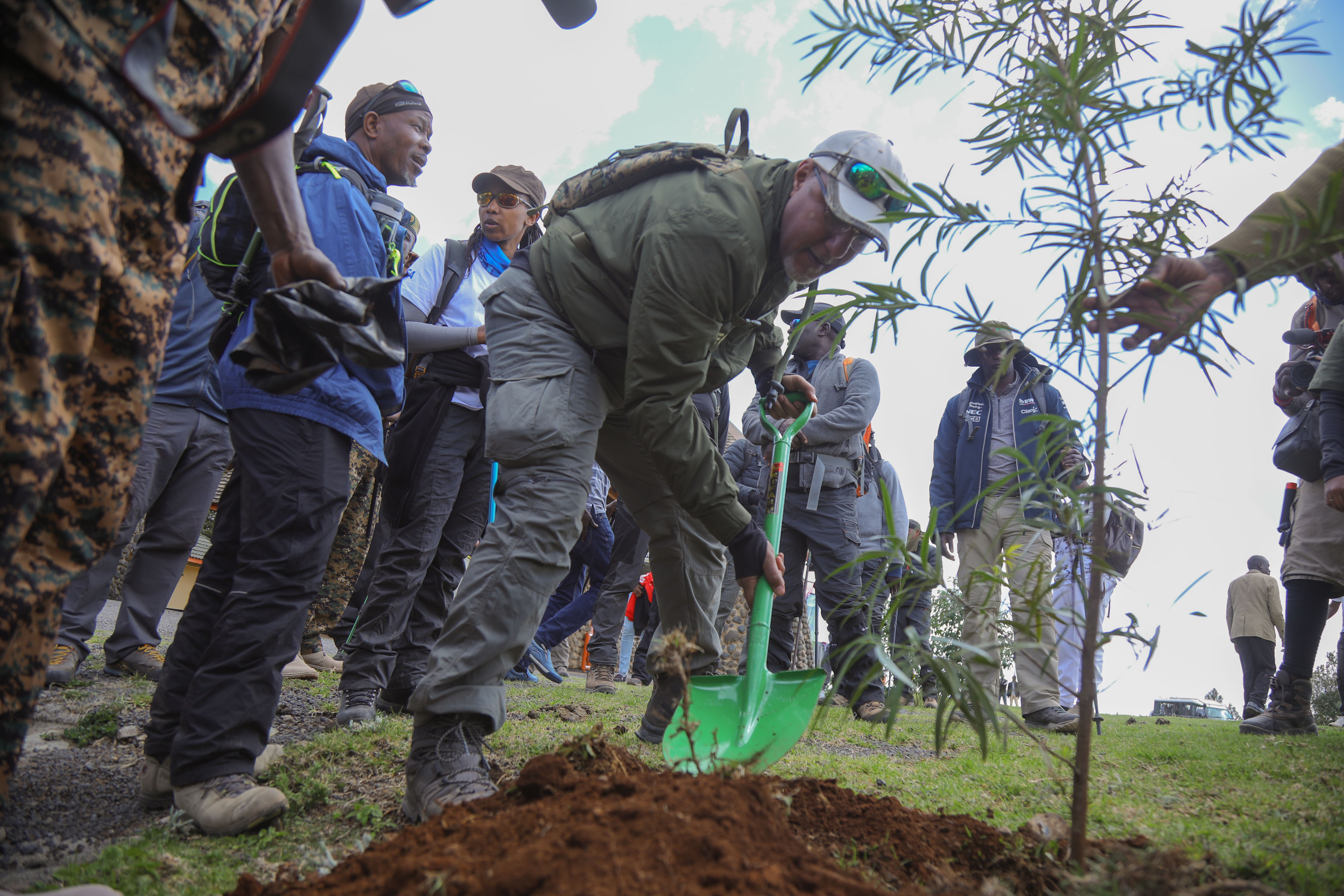
curtly cut bucket list expedition whose goal was to raise funds for the
upgrading of existing visitor facilities along the mountain’s routes. For
starters, one cannot climb a mountain of this magnitude without a team. More
than personal skill, teamwork is the rope that will hoist you to the summit.
Leading the expedition was Malindi-born Julian with
his African Ascents retinue of mountain-hardened guides, cooks and porters.
Julian is quite the outdoorsy fellow with years of guiding safari across the
Kenyan landscape. Complementing his service was a mountain rescue team from the
Kenya Wildlife Service led by acclaimed Senior Warden Simon Gitau whose
experience calmed any incident nerves. Their core function is to pre-empt any
risks that may occur on the mountain and the corrective action to be taken. I
also had the singular honour of hiking the Tourism and Wildlife Cabinet
Secretary (CS) Najib Balala, the Director General of Kenya Wildlife Service
Brig. John Waweru, Managing Director, M-PESA Africa and acting Chief Financial
Services Officer at Safaricom Sitoyo Lopokoiyit, the country manager of Visa, Eva
Ngigi-Sarwari, Vipingo Ridge Chairman, Alastair Cavenagh and Sahihi Interior
Builders Director, Njehia Njoroge. A physiotherapist and camera crew wound up
the team.
Respect the
process
Day 1:
CHOGORIA SPECIAL CAMP
START: 7,743ft
/ 2360m
END:
8,301FT / 2530M
DISTANCE: 6 Miles
/ 10Kilometres
TIME: 5hrs
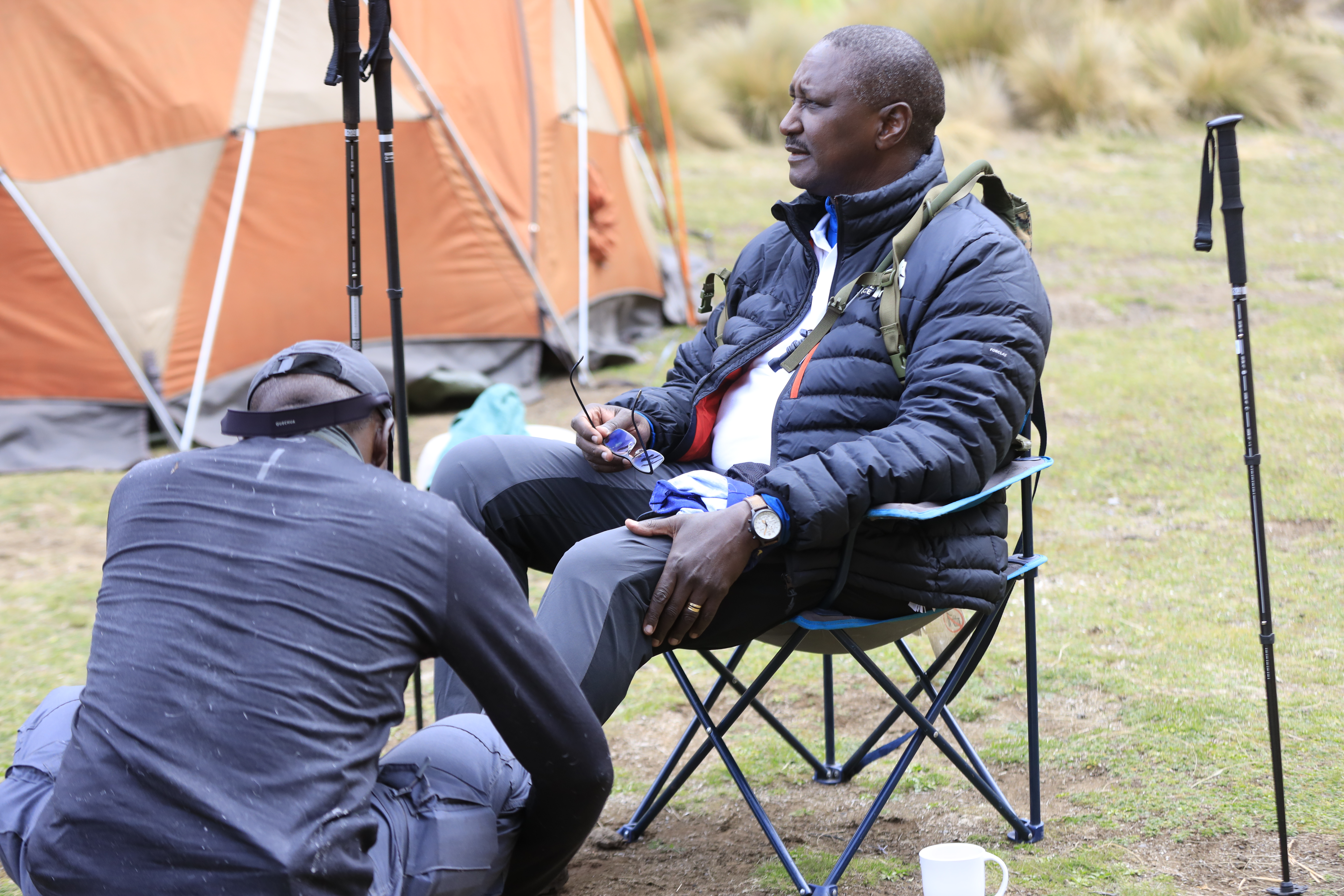
Dawn. A flight to Embu followed by transfers to the
park entrance and on to Chogoria’s Anabas Cottage Camp located at the foothill
of the mountain where all gear was inspected. A hearty trout lunch marked the
beginning of an animated hour-long walk through montane forest teeming with
giant camphor, figs, cedar and the yellowwood. Upon arrival to the Chogoria
Special Camp, the battery entourage broke off to allow the hikers acquaint
themselves with camp and the journey ahead. Ours was a clear evening that
offered a sense of the landscape from this point. A brief acclimation walk
revealed how the hundreds of acres of indigenous forest that were burned to
black ash, blighting picturesque green slopes were regenerating. As darkness
set in, I sidestepped the VIP mess to share the dinner first with the guides
and mountain rescue team for a feel of a day in their life. Ugali ‘beefed’ up
with cabbage, paired by mountain stories and tea was enough to ready me for the
adventure that lay ahead. I did, however, pop in the central mess shaped like a
half ball in time for an impressive cheese cake dessert. Not a bad start, I
thought to myself as I tucked into the sleeping bag, on a camp bed, spotting a
hot water bottle in what I can only describe as a delightful glamping
accommodation.
Morning came and the reality set in. Passport showers,
camp breakfast and after a stretch, the party set off for a relaxed five-kilometre
walk to Chogoria Roadhead for the first break before the 100-metre descent
Nithi Falls. I reckon that the minimal animal encounters were the result of the
green season that would have pushed game off this altitude. All I caught was a
bird, four black birds with yellow bellies to be precise, to this point where
the Afro- alpine forest ended and the moorland begun. Everyone enjoyed their break differently I
couldn’t help but observe; Julian kept a keen eye over everyone as he would the
entire trip, Alistar rested on the ground with his elbow as a prop, Eva, CS
Balala and DG Waweru took the bench as the physiotherapist got active, while
the guides cracked jokes in Kikuyu dialect.
Step into heaven
Day 2: LAKE
ELLIS
START: 8,301ft
/ 2530m
END:
11,417ft / 3480m
DISTANCE: 5 Miles/
8Kilometres
TIME: 4 Hrs
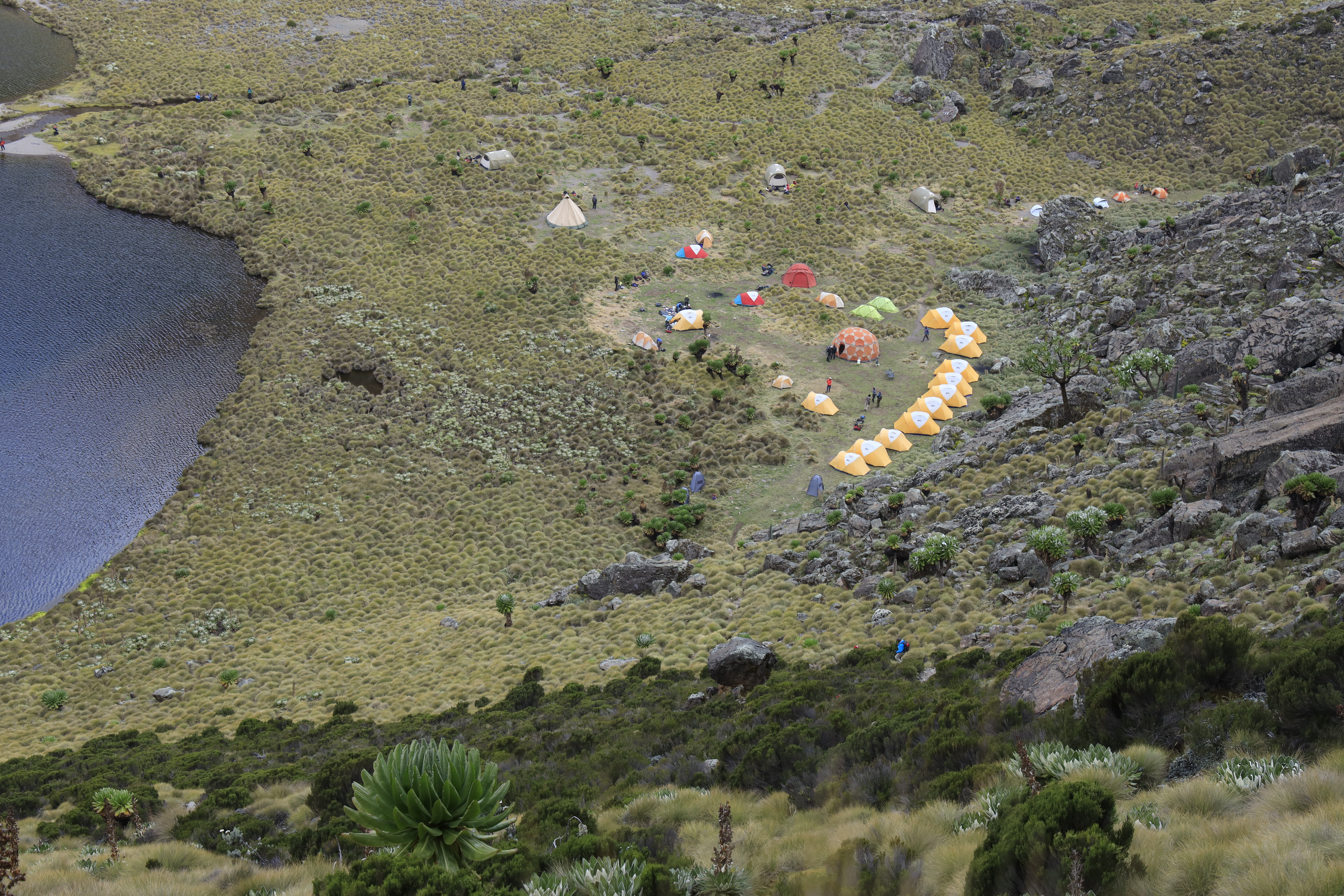
The gods favoured our roughly four-hour walk with fair
weather that allowed for spectacular views of the rolling hills ahead and
glimpses of the snow- capped peaks of Batian (5,199m) and Nelion (5,188m) high
above ushering us to Lake Ellis in the afternoon. A dip in Ellis’ icy waters
triggered memories of winter swimming in Estonia only without the sauna session
after. A warm meal sufficed with an option of an evening walk up to nearby Mugi
Hill. Siesta’s and a spot of fly-fishing in the lake, however, was the choice
way to end the day. Being the last stop for vehicles it was interesting
watching the porters troop in for their assignment the following morning.
Historically, I would learn, this was also the farthest African inhabitants
mostly reached before properly kitted pioneer mountaineers began forays to open
up the mountain. Dinner on this night was tomato soup, rice marked by beef
strips and orange with a twist for dessert.
The moon was full, the stars close and they shone
right into my tent. I did fall asleep easily but 3,480 metres was the highest I
had ever been and my body took notice. I woke up with strained breathing at 2am
and stepped out to try out the portable bush toilets for the first time. Yoga
breathing techniques aided calm my nerves as I caught hares in my head lamp,
listened to the excited whoops of hyena amid mates’ snoring and sleep talking.
Peak into heaven
Day 3: LAKE
MICHAELSON
START: 11,417ft
/ 3480m
END: 14,075ft
/ 4290m
DISTANCE: 5 Miles
/ 8Kilometres
TIME: 7 Hrs
The Chogoria route is considered the most picturesque
on the mountain. This section left a lasting impression. It is here that I
appreciated the camaraderie hiking builds from the hearty conversations
savoured. What made it more special was its generous serving of views. On our
back was Ellis in her majesty, revealed after a steep incline along the ridge
overlooking the Gorges Valley. We were all in awe, taking frequent glances with
only the porters seeming not to feel inclined, the 18-kilo packs on their backs
notwithstanding. As lush green turned to barrenness, the chatter reduced with
everyone looking forward to the lunch break. I have to mention that my
Oppo-make cell phone was the only network capable cell phone from this point
on. This triggered technology withdrawal symptoms among the travelling party
and hotspotting became an active sport.
The taxing climb was marked by Afromontane moorland in
which tree groundsel, the sentry-like giant groundsels and Lobelia Telekii rose
defiantly out of a ground of tussocky grasses and everlastings, a breath-taking
reward I would return for. If I had thought Ellis charming, then this is
without doubt Mount Kenya’s crown jewel. Located in the Gorges Valley, above
Vivienne Falls and surrounded by the 300m cliff, aptly christened Temple Walls,
we caught our first glimpse of the glorious Lake Michaelson. The 30-acre jade
water body that feeds the Nithi River is the second largest of the lakes and
tarns on Mount Kenya. It is named after a friend of Halford Mackinder, a
geographer and the first European explorer to summit Mount Kenya back in 1899.
Getting to her, however, would not be as easy as the trail is wet and unsecured. It is on this chancy descent where hyrax, the
most obvious inhabitants rubbernecked the struggling two-legged visitors
propped up by hiking poles that we suffered our first incident.
According to Lameck Naliali, the expedition
physiotherapist who would recommend a precautionary evacuation, DG Waweru
likely tore his anterior cruciate ligament tear. The mishap notwithstanding,
the entire team made it to the gem with cheer all around. As had become custom
the brave few dove in while the patient went fishing. Dusk fell fast and we all
hurdled for the warmth of the gas heated mess tent. While the conversation was
the liveliest on this night, the meal was the blandest. Vegetable soup preceded
a beef burger whose chew was affected by the cold, I suspect. Thankfully, a
health sprinkling of cheese and Njehia’s industry had paid off and we all
partook in welcome bites of eight fresh trout fished.
As the night wore on, I left the team playing cards
and went to listen to Elijar Mbiti, an experienced guide who knows the mountain
like the back of his hand. His thrilling tales of the mountain include one
expedition that helped open up a fresh route. Despite going to bed way after
everyone had slept, my body again jolted awake in the twilight of the morning
and I found myself on the lakeshore. As fate would have it, I reckon myself to
be the only one that the gods favoured with a peak into his dominion. Through a
gap of the Temple Wall, well centred at the furthest end of the still lake akin
to the fabled pearly gates, a magnificent orange and crimson light announced
the rising sun in an ideal fusion of a true and daily paradise. I admit this to
be the most stunning sunrise I have ever witnessed. So exquisite was it that I
stood transfixed, unable to even call out to the camera crew to bottle up its
magic. Its beauty was such a powerful force, one capable of imparting its
warmth on the most hardened of souls. At that very moment, I understood why my
ancestors referred to this mountain as the Seat of God.
Clawed by Simba
Day 4: SIMBA
TARN
START: 14,075ft
/ 4290m
END: 15,256ft
/ 4650m
DISTANCE: 2 Miles
/ 3Kolmetres
TIME: 2 Hrs
This was a slow morning spent taking in the immense
beauty at the breakfast table. Turns out that it would also be the last gift Mt
Kenya would dish out for me for after breakfast, a dip in the refreshingly icy
waters followed by a sunbathing session while slender billed starlings
serenaded us with their endless chatter, everything seemed to go south. First,
DG Waweru was evacuated then a mental and physical test from Lake Michealson to
Simba Col nestled in a bowl on the shoulder of Point Lenana at 4500 meters
begun. While the distance was short, it was a steep climb marked by mosses and
lichens. At the marker to Austrian hut, the mountain patted me out.
No love lost
Day 5: LENANA
SUMMIT / OLD MOSES
START: 15,256ft
/ 4650m
END: 9,974ft
/ 3040m
DISTANCE: 11 Miles
/ 17Kilometres
TIME: 8 Hrs
I am laying in my bed admiring the Batian peak showing
off from my room at Soames. Social media is beaming with report of CS Balala’s
second successful summit as the credits roll on the film The Ascent, which I have just finished watching.
Produced in 1994 by Njeri Njiiri Karago, current
Kenyan Consul-General for the consulate in Los Angeles, this romantic account
of Mount Kenya is billed as the "highest altitude film” ever made. Based
off the true-life account of Felice Benuzzi published in 1946 No Picnic on Mount Kenya: A Daring Escape, A
Perilous Climb, this mountaineering classic recounts the seventeen-day-long
quixotic quest preceded by eight months of planning by three escaped Italian POWs
from British POW Camp 354. There are not many people who would break out of a
jail, trek for days across perilous terrain guided by an image embossed on a
tin of compressed beef (Kenylon brand), meagre rations, and with improvised
equipment like hand-crafted crampons and ice axes converted out of stolen
hammer. There are probably fewer still that would break back in to the camp on
their return. After my bucket-list experience, I understand why I would have
volunteered to join this lunatic gang.
At lunch a few hours later, I would listen in
reverence to the tales of a sub-zero night, a dawn wake-up call and a laboured
stab for the sunrise reward that was 4650M Point Lenana. Should you try Mount
Kenya, it is paramount that you have proper gear and an evacuation plan. It not
only makes your trip easier, more comfortable, but more enjoyable as well.
Importantly, do not do it alone, after all, borrowing from the catchphrase from
The Ascent, “a man who climbs alone,
climbs for the wrong reasons”.